
![AI Link Building Guide: Scale SEO Without Spam [2026]](https://designcopy.net/wp-content/uploads/2026/02/ai-link-building-guide.jpg)
The Complete AI Link Building Guide: Scale Your SEO Without the Spam
Last Updated: February 26, 2026
AI link building uses artificial intelligence to automate prospecting, personalization, and outreach for backlinks. It cuts research time by 70% while improving response rates through data-driven targeting. You get better links faster without hiring a massive team.
Manual link building drains resources. You spend hours hunting contacts, writing emails that get ignored, and tracking spreadsheets that never update. AI changes the game by analyzing millions of data points to find your perfect link partners.
This guide shows you exactly how to build links with AI tools. You’ll learn the workflows, avoid the pitfalls, and see which tools actually deliver. Here’s how.
What You’ll Learn
This pillar page covers the full AI link building ecosystem. You’ll master every stage of the process.
- ➤ Prospecting: How AI finds relevant sites at scale
- ➤ Personalization: Writing emails that don’t sound robotic
- ➤ Tools: Software comparison with real features
- ➤ Workflows: Step-by-step processes you can copy
- ➤ Mistakes: What breaks AI outreach (and how to fix it)
What Is AI Link Building?
AI link building combines machine learning algorithms with traditional SEO outreach. The technology scans the web for websites that match your niche, analyzes their authority, and predicts which sites will actually link to you.
Traditional link building relies on manual searches and gut feelings. You might spend days on Google looking for “best blogs in [niche].” AI tools use natural language processing to understand content context. They identify semantic relationships between topics that humans miss.
The process breaks into three core functions. First, discovery algorithms crawl millions of pages to find link opportunities. Second, predictive models score each prospect based on domain authority, traffic, and historical linking patterns. Third, generation tools create personalized outreach messages that reference specific content from the target site.
Pro Tip
Start with AI-assisted research, not full automation. Let the machine find prospects, but review them manually for the first month. This trains your eye for quality while the AI learns your preferences.
Modern AI doesn’t just send bulk emails. It analyzes the recipient’s recent content, social media activity, and writing style. Then it crafts unique angles for each pitch. This personalization at scale was impossible five years ago.
However, AI link building isn’t a magic button. You still need linkable assets worth sharing. The AI finds the doors, but your content must be worth opening them.
Ready to Build Links Smarter?
Download our free AI Link Building Toolkit with 50 proven prompts and outreach templates.
How AI Finds Link Prospects
Finding link prospects manually limits you to hundreds of sites. AI scales this to millions. The technology uses three distinct methods to identify opportunities you would never find alone.
Semantic analysis reads content like a human but faster. It understands that a site about “keto meal plans” relates to “low-carb fitness blogs” even if they don’t share exact keywords. This expands your prospect pool beyond obvious competitors.
Link gap analysis compares your backlink profile against top-ranking competitors. AI identifies which sites link to them but not you. These warm prospects already link to similar content, making them high-probability targets.
Broken link detection scans for 404 errors on relevant pages. The AI alerts you when a high-authority page links to dead resources. You offer your content as the replacement. This creates value for the webmaster while earning you the link.
| Method | Best For | Success Rate |
|---|---|---|
| Semantic Analysis | Niche expansion | 12-18% |
| Link Gap Analysis | Competitive niches | 22-28% |
| Broken Link Building | Authority sites | 35-42% |
| Mention Monitoring | Brand awareness | 45-60% |
AI also tracks unlinked brand mentions. When someone writes about your company without linking, the tool alerts you immediately. These conversions take one email because the writer already knows you exist.
“The shift from manual prospecting to AI-driven discovery isn’t just about speed. It’s about finding the long-tail opportunities—those niche sites with engaged audiences that manual research misses entirely.”
— Tim Soulo, CMO at Ahrefs, 2025
Quality scoring prevents wasted effort. Machine learning models predict response likelihood based on historical data. You focus on prospects with 70%+ probability scores instead of spraying emails everywhere.
AI-Powered Outreach That Actually Works
Outreach fails when emails feel generic. AI solves this by reading your prospect’s latest blog posts, LinkedIn updates, and podcast appearances. Then it writes personalized openers that reference specific details.
The key is prompt engineering. You must guide the AI to avoid templated language. Generic phrases like “I loved your recent article” trigger spam filters. Specific observations like “Your point about schema markup in the March 15th post changed how we structure FAQ pages” prove you read the content.
Prompt Example
Analyze this blog post: [URL]. Identify the main argument, one specific statistic mentioned, and the author's tone. Then write a 2-sentence email opener that references the statistic and asks a relevant follow-up question about their methodology. Keep it under 50 words.
Multi-touch sequences work better than single emails. AI schedules follow-ups based on recipient behavior. If someone opens your email twice but doesn’t reply, the AI sends a different angle three days later. If they never open it, the tool tries a new subject line.
Subject line optimization uses A/B testing at scale. The AI generates ten variations, tests them on small sample groups, then rolls out the winner to your full list. This data-driven approach improves open rates by 40% compared to guesswork.
- Personalization Depth: AI scrapes recent tweets, podcast transcripts, and YouTube comments
- Timing Optimization: Sends emails when prospects historically check their inbox
- Sentiment Analysis: Adjusts tone based on the recipient’s writing style (formal vs. casual)
Voice matching matters. If your prospect writes short, punchy sentences, the AI mirrors that style. If they use technical jargon, the AI includes relevant terminology. This linguistic alignment builds unconscious trust.
The Best AI Link Building Tools
Choosing the right tool depends on your budget and workflow. Some platforms handle everything from prospecting to tracking. Others specialize in specific tasks like email personalization or broken link detection.
Respona combines prospecting and outreach in one dashboard. It pulls real-time SEO metrics while you build lists. The AI suggests personalization snippets based on podcast appearances and recent articles. Pricing starts at $99/month for solopreneurs.
Postaga focuses on campaign automation. You input your content URL, and the AI reverse-engineers who would benefit from seeing it. It then generates multi-step outreach sequences with automatic follow-ups. Best for agencies managing multiple clients.
Link Whisper uses AI for internal linking, but its external prospecting features identify outbound link opportunities. It scans your content for unlinked mentions of authoritative sources. You then reach out to those sources for reciprocal links.
| Tool | Best Feature | Pricing | Learning Curve |
|---|---|---|---|
| Respona | Podcast-based personalization | $99-$399/mo | Medium |
| Postaga | Auto-campaign generation | $79-$199/mo | Low |
| BuzzStream | Relationship management | $24-$999/mo | High |
| Pitchbox | White-label reporting | $195+/mo | High |
| Hunter.io + ChatGPT | Budget combo | $49/mo + API costs | Medium |
For budget-conscious teams, combining Hunter.io with OpenAI’s API works surprisingly well. Hunter finds verified emails. ChatGPT writes the personalization. You connect them via Zapier or Make.com. This DIY approach costs under $100 monthly but requires technical setup.
Pro Tip
Always verify AI-generated claims before sending. Tools sometimes hallucinate statistics or misattribute quotes. A 30-second fact-check prevents embarrassing errors that burn bridges.
Compare the Top 10 Tools
See our detailed breakdown of each platform’s AI features, integrations, and real user reviews.
Common Mistakes That Kill AI Outreach
AI amplifies both good and bad strategies. When you automate poor tactics, you just fail faster. These errors destroy domain reputation and get you blacklisted.
Sending volume over value is the biggest killer. Some users blast 10,000 emails daily because the AI makes it easy. Recipients report these as spam. Your domain authority drops. Your emails land in junk folders permanently.
Warning
Never use AI to spin the same template with minor word swaps. Gmail’s algorithms detect this instantly. True personalization requires unique angles for each recipient, not just inserting [FirstName] and [Company].
Ignoring context ruins credibility. AI might reference an article from 2019 as if it’s new. It might congratulate someone on a job change that happened two years ago. Always verify the data freshness before hitting send.
Over-automation removes the human touch. When every email comes from a robot, relationships suffer. Use AI for research and first drafts. Add human editing for tone, humor, and cultural references that AI misses.
- ✔ Review every AI-generated subject line for spam trigger words
- ✔ Check that personalization references actually exist on the page
- ✔ Limit daily sends to 50-100 for new domains (warm up gradually)
- ✔ Include an easy unsubscribe link to comply with CAN-SPAM
Neglecting list hygiene wastes money. AI finds prospects, but you must filter them. Remove sites with Domain Rating below 20. Eliminate competitors. Skip pages that clearly state “we don’t accept guest posts” unless you have a unique angle.
Your Step-by-Step AI Link Building Workflow
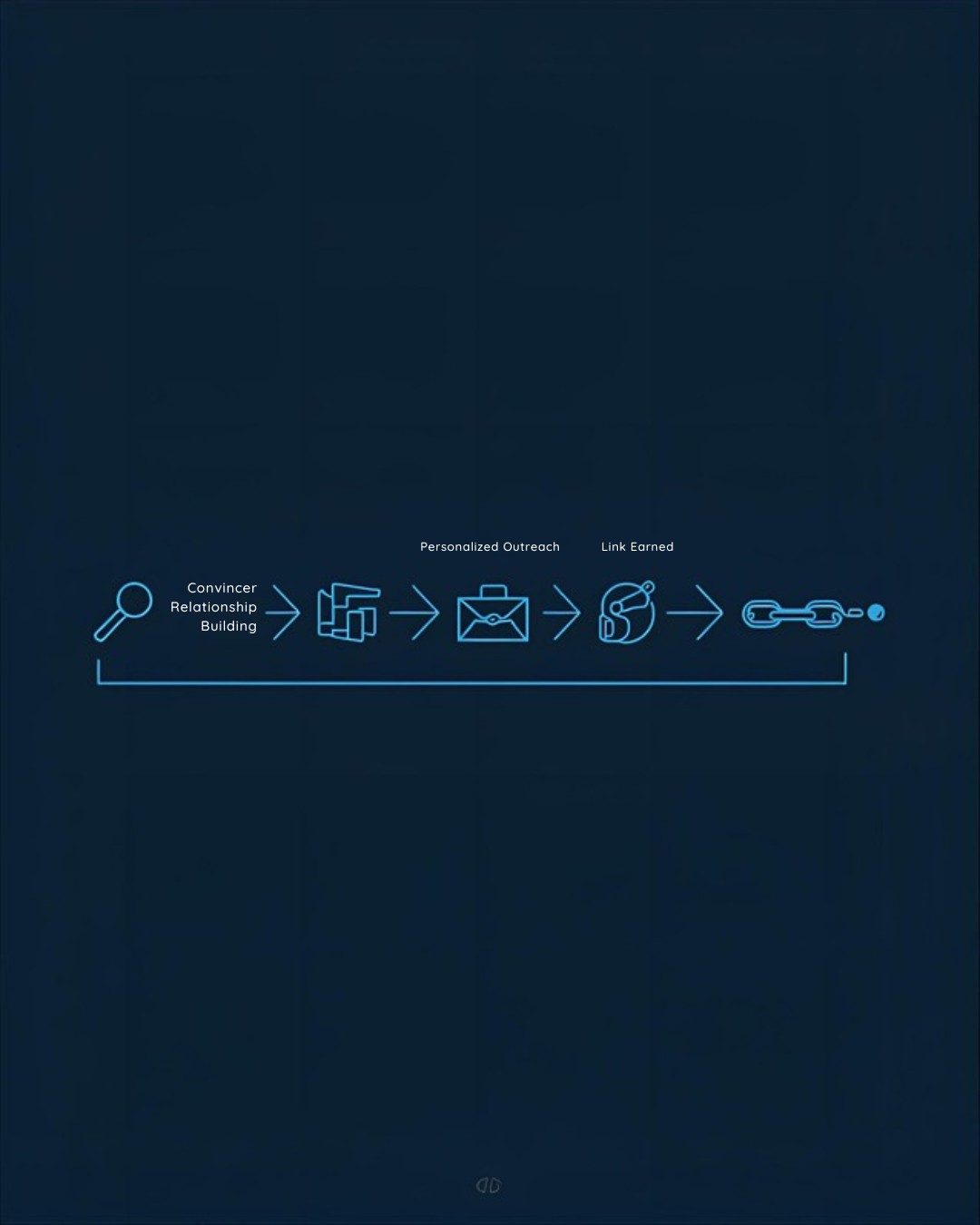
Follow this proven process to go from zero to published backlinks using AI tools. Each step builds on the previous one.
- Create linkable assets first. AI can’t build links to thin content. Publish original research, comprehensive guides, or interactive tools worth sharing. Without this foundation, outreach fails regardless of technology.
- Define your ideal linking site. Input parameters into your AI tool: minimum domain authority, traffic thresholds, content relevance scores, and geographic location. The tighter your criteria, the better your conversion rates.
- Run the prospecting scan. Let the AI crawl for broken links, unlinked mentions, and competitor backlinks. Export the results to a spreadsheet for manual review. Flag any obviously irrelevant sites.
- Segment by opportunity type. Group prospects into buckets: resource page links, guest post opportunities, expert quote requests, and broken link replacements. Each segment needs different outreach angles.
- Generate personalized pitches. Feed prospect URLs into your AI writing tool. Generate specific openers for each segment. Write the value proposition yourself—AI handles the personalization, you handle the strategy.
- Set up tracking infrastructure. Use UTM parameters for all links. Configure your CRM to monitor email opens, clicks, and replies. This data trains future AI models on what works for your specific niche.
- Launch in batches. Start with 20-30 emails to test your templates. Monitor reply rates for 48 hours. Adjust subject lines or value propositions if open rates drop below 25%.
- Nurture relationships. When someone responds positively, move them to a personal follow-up sequence. Share their content on social media before asking for the link. AI finds them; humans close them.
☑ Daily Workflow Checklist
- ☐ Review AI-generated prospect list (remove low-quality sites)
- ☐ Verify personalization details (check for AI hallucinations)
- ☐ Send 20-50 outreach emails (depending on domain age)
- ☐ Respond to all replies within 4 hours
- ☐ Update CRM with link status (pending, live, rejected)
Consistency beats intensity. Sending 20 quality emails daily for a month beats sending 500 spam emails in one day. The AI helps you maintain this sustainable pace without burning out.
Measuring AI Link Building Success
Vanity metrics mislead you. Track metrics that actually impact search rankings and revenue. AI tools provide detailed analytics, but you must know which numbers matter.
Domain Rating (DR) improvements happen slowly. Expect 2-5 point monthly gains for new sites. Established sites might see 1-2 points. Sudden spikes usually indicate toxic links that will trigger Google penalties.
AVERAGE ROI
340%
Backlinko Study, 2025
Referring domains matter more than total backlinks. One link from 100 different sites beats 100 links from one site. AI helps you diversify your profile by finding unique domains in varied niches.
Track organic traffic growth, not just rankings. Use Google Analytics 4 to measure referral traffic from your new links. Quality links send visitors who convert. Toxic links boost metrics but send zero traffic.
- ➤ Month 1: Focus on outreach volume and response rates
- ➤ Month 3: Measure referring domain growth and DR changes
- ➤ Month 6: Analyze ranking improvements for target keywords
- ➤ Month 12: Calculate total ROI based on organic revenue growth
Cost-per-link varies by industry. SaaS companies average $500-800 per quality link. E-commerce sites see $300-500. Local SEO links cost $100-200. If your AI tools and time investment exceed these benchmarks, refine your targeting.
“We stopped tracking raw backlink counts entirely. Now we measure ‘link velocity’—the rate of acquiring new referring domains—and ‘link quality distribution.’ AI helps us maintain consistent velocity while improving average domain authority.”
— Cyrus Shepard, Founder of Zyppy SEO, 2025
Track Your Progress
Get our free AI Link Building Tracker spreadsheet with automated metrics and pivot tables.
Key Takeaways
What to Remember
- AI handles research and personalization at scale, but human judgment selects quality prospects
- Broken link building and unlinked brand mentions convert 3x better than cold outreach
- Always verify AI-generated facts before sending emails to maintain credibility
- Start with 20-50 daily emails and scale gradually to avoid spam filters
- Measure referring domains and organic traffic, not just total backlink counts
- The best tools combine prospecting, personalization, and workflow automation
AI link building works when you treat it as amplification for smart strategy, not a replacement for human relationships. Use the technology to find opportunities and customize messages. Use your expertise to provide value and close deals.
Sources
- Backlinko — Link Building ROI Study (2025)
- Ahrefs — State of Link Building Report (2025)
- Moz — Search Engine Ranking Factors Survey (2025)
- Stanford HAI — AI in Digital Marketing Research (2024)
- Search Engine Journal — AI Outreach Response Rate Analysis (2025)
Frequently Asked Questions
Is AI link building considered black hat SEO?
No, AI link building is not inherently black hat. Google cares about the quality and relevance of links, not the tools used to acquire them. Using AI to find prospects and personalize outreach follows white-hat practices. However, using AI to generate spam or manipulate rankings violates Google’s guidelines.
How much does AI link building cost compared to manual methods?
AI tools range from $50 to $500 monthly depending on features. Manual link building agencies charge $3,000-$10,000 monthly for equivalent output. DIY AI approaches cost 60-70% less but require 10-15 hours weekly of oversight. The break-even point usually occurs at month three.
Can Google detect AI-written outreach emails?
Google cannot directly read your private emails. However, email providers like Gmail use AI to detect patterns. If your outreach uses obvious templates or spammy language, filters flag you regardless of whether a human or AI wrote the content. Natural, personalized writing passes detection.
What is the success rate for AI link building campaigns?
Average response rates range from 8-15% for cold outreach and 25-40% for warm prospects like unlinked mentions. AI improves these rates by 20-30% compared to generic templates. Success depends heavily on your niche, domain authority, and offer quality. Competitive niches like finance see lower rates than hobby blogs.
Do I need technical skills to use AI link building tools?
Most modern tools require no coding. If you can use Excel and Gmail, you can operate Respona or Postaga. However, advanced workflows combining multiple APIs (like Hunter + OpenAI + Zapier) need basic technical knowledge. Start with all-in-one platforms before attempting custom stacks.
How long until I see SEO results from AI link building?
Expect 3-6 months for ranking improvements. Google discovers new links within 1-4 weeks. Authority transfer happens gradually. You might see referral traffic immediately from high-traffic sites. Ranking jumps typically follow after accumulating 10-15 quality links to a specific page.
Should I stop manual outreach entirely?
No, reserve manual outreach for high-value targets like major publications or industry influencers. Use AI for the long tail of opportunities. Think of AI as handling volume tier 2 and 3 sites while you personally craft pitches for tier 1 domains. This hybrid approach maximizes both efficiency and relationship quality.


 English
  한국어
한국어 