

The Complete AI Search Evolution Guide: From Keywords to Conversations
Last Updated: February 26, 2026
AI search evolution is the transformation from keyword matching to semantic understanding and answer generation. Modern search engines use large language models to interpret intent and generate direct responses rather than simply ranking web pages. This shift reduces traditional organic traffic for informational queries while creating new opportunities for brand authority and commercial intent capture. You need to adapt your content strategy to focus on topical authority and structured data markup. Let’s break down exactly how search has changed and what you need to do now.
What You’ll Learn
- How search engines transitioned from PageRank to neural networks
- The specific impact of AI Overviews on click-through rates
- Technical optimization tactics for conversational search
- Entity-first SEO strategies for 2026 and beyond
- How to optimize for ChatGPT Search and Perplexity
What Is AI Search Evolution?
AI search evolution describes the fundamental change in how search engines process and respond to queries. Traditional search relied on keyword indexing and link authority to rank blue links. Modern AI search uses natural language processing to understand context, generate summaries, and provide direct answers. This represents a move from retrieval-based systems to generative systems.
The transition began with RankBrain in 2015, accelerated with BERT in 2019, and reached a tipping point with large language models in 2023. Google’s Search Generative Experience (now AI Overviews) and competitors like ChatGPT Search mark the definitive shift toward conversational, answer-first interfaces. These systems don’t just find relevant pages—they synthesize information from multiple sources.
This evolution changes the user journey. Searchers now get answers without clicking through to websites. For content creators, this means optimizing for visibility within AI-generated summaries rather than just ranking position. You need to structure content so AI systems can extract and cite your expertise accurately.
Traditional inverted indexes matched exact keywords to documents. Vector search converts text into mathematical representations, allowing semantic matching between queries and content. This means your page about “automobile maintenance” can rank for “car repair tips” even without exact keyword overlap. The system understands these phrases represent the same intent.
Pro Tip
Focus on topical clusters rather than individual keywords. Create comprehensive content that covers entire subjects so AI systems recognize you as the primary source for citations.
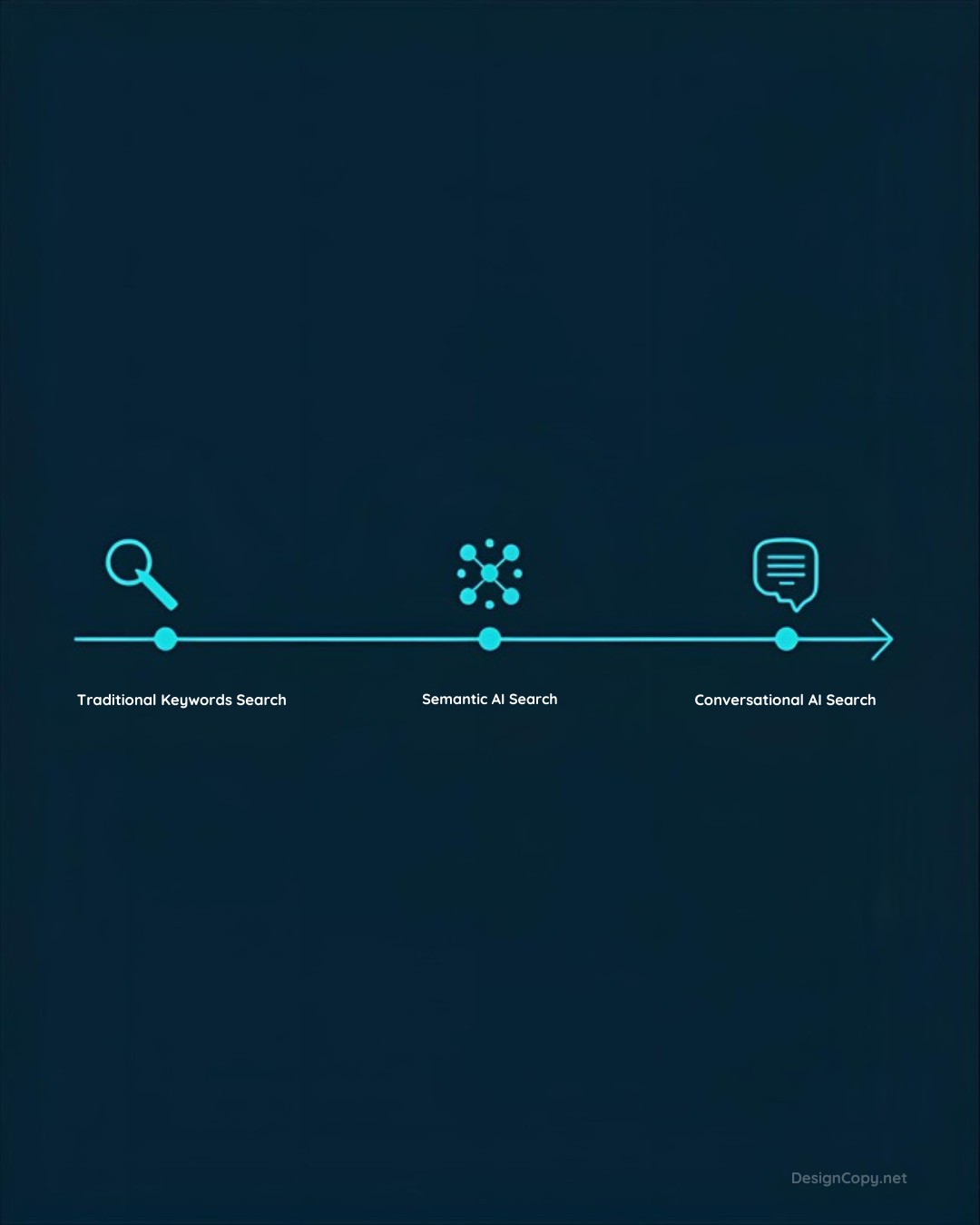
The Three Phases of Modern Search
Search technology has progressed through distinct phases over the past decade. Understanding these phases helps you identify which optimization tactics still work and which need replacement. Each phase built upon the previous but introduced new ranking factors and user expectations.
The Keyword Phase (2010-2018) relied heavily on exact-match keywords, meta tags, and backlink quantity. SEOs optimized for specific phrases and built extensive link networks. The Intent Phase (2019-2022) introduced BERT and natural language understanding. Google began interpreting query context rather than just matching words. The current Generation Phase (2023-present) uses AI to create answers rather than just rank pages.
| Phase | Key Technology | SEO Focus | User Experience |
|---|---|---|---|
| Keyword (2010-2018) | PageRank, Inverted Index | Exact-match keywords, backlink volume | Ten blue links |
| Intent (2019-2022) | BERT, Neural Matching | Semantic relevance, user intent | Featured snippets, People Also Ask |
| Generation (2023-Now) | LLMs, Vector Search | Entity authority, structured data | AI Overviews, conversational answers |
Each phase rendered previous tactics obsolete while introducing new requirements. Keyword stuffing died in the Intent Phase. Now, basic keyword optimization alone dies in the Generation Phase. You need entity relationships and clear information architecture to survive.
The transition between phases creates turbulence for websites. Sites that dominated keyword rankings often lost visibility during the Intent Phase if they lacked semantic depth. Similarly, sites relying on featured snippets now face zero-click searches as AI Overviews provide answers directly. The window for adaptation closes quickly once a phase matures.
AI OVERVIEW ADOPTION
47%
of searches now trigger AI-generated responses (2026)
Master AI Search Optimization
Join 12,000+ SEO professionals getting weekly tactics for AI search visibility. No fluff, just actionable strategies.
How AI Overviews Impact Your Traffic
AI Overviews fundamentally alter the click-through rate for informational content. When Google displays a generated answer at the top of results, users often find what they need without visiting source websites. This creates a zero-click environment for definitional and how-to queries.
Data from early 2025 shows informational queries experienced 15-30% drops in organic CTR when AI Overviews appear. However, commercial and transactional queries maintain stronger click-through rates because users want to compare options before purchasing. AI Overviews actually boost traffic for complex queries by simplifying concepts and encouraging deeper exploration.
“We’re seeing a bifurcation in search behavior. Simple questions get answered instantly by AI, but complex purchase decisions still drive clicks to authoritative sources. The key is targeting investigative intent rather than basic informational queries.”
— Dr. Sarah Chen, Search Intelligence Director at Metric Labs, 2025
Your content strategy must account for this bifurcation. Stop creating thin content that answers simple questions in 300 words. Instead, build comprehensive resources that AI systems must cite because the answer requires depth, nuance, or visual elements that text summaries cannot provide.
Warning
Websites relying on “what is” and “how to” content for ad revenue face existential threats. Diversify into comparison tools, interactive calculators, and original research that AI cannot easily replicate.
Monitor your Search Console data for queries triggering AI Overviews. When you see impressions without clicks increasing, that query has likely been absorbed into generated answers. Pivot that content toward related topics requiring human judgment or personal experience.
Optimizing for Conversational AI Search
Conversational AI search requires different content structures than traditional SEO. Users ask ChatGPT Search or Perplexity full questions rather than typing fragmented keywords. They expect dialogue-style responses and follow-up capabilities. Your content must satisfy these natural language patterns.
Start by identifying conversational queries in your niche. Use “People Also Ask” data, forum discussions, and AI chat logs to find how users actually phrase questions. Map these to long-tail variations that include question words: who, what, where, when, why, and how.
- Analyze conversational patterns: Review ChatGPT threads and Reddit discussions to identify natural phrasing for your topics.
- Create FAQ schema markup: Implement structured data for questions and answers to help AI systems extract your content accurately.
- Write direct answers first: Place clear, concise answers in the first 50-60 words of sections, then expand with detail.
- Use natural language headers: Replace keyword-stuffed H2s with questions users actually ask aloud.
- Build semantic context: Surround primary topics with related entities and concepts to establish topical authority.
This approach helps AI systems understand your content boundaries and citation worthiness. When ChatGPT Search references your site, it pulls from clearly defined sections that directly address specific user intents.
Prompt Example
Analyze the top 10 conversational queries for [your topic].
Identify the underlying intent (informational, comparative, transactional).
Suggest content structures that provide definitive answers while
encouraging users to click for detailed implementation steps.
Test your content against AI search engines directly. Query Perplexity or ChatGPT Search with questions your content answers. If the AI generates a response without citing your site, your content lacks sufficient authority signals or clear answer formatting.
Entity-First SEO Strategy
Entity-first SEO prioritizes the relationships between concepts rather than keyword density. Search engines now build knowledge graphs that connect entities—people, places, things, and ideas—across the web. Your goal is to establish your content as the authoritative node for specific entities in your niche.
Start by identifying the core entities relevant to your business. If you sell project management software, your entities include methodologies (Agile, Scrum), roles (project manager, scrum master), and tools (Gantt charts, kanban boards). Connect these entities through comprehensive content that explains their relationships.
☑ Entity Optimization Checklist
- ☐ Implement Organization schema markup on your homepage
- ☐ Create “About” pages that clearly define your core entities and expertise
- ☐ Use consistent naming conventions across all content (e.g., “Project Management” not mixed with “PM”)
- ☐ Build internal links between related entity pages using descriptive anchor text
- ☐ Claim and optimize your Google Knowledge Panel if eligible
Structured data markup becomes critical in the entity-first era. Schema.org vocabulary helps search engines understand not just what your page says, but what it represents. Use Article, Author, Review, and specific entity schemas to clarify your content’s role in the knowledge graph.
- ➤ SameAs Links: Connect your entities to authoritative sources like Wikipedia, Wikidata, and industry databases
- ➤ Disambiguation: Clarify when your entity shares a name with others (e.g., “Apple” the company vs. the fruit)
- ➤ Relationship Mapping: Explicitly state how entities relate using clear semantic triples (Subject-Predicate-Object)
Download the AI Search Optimization Toolkit
Get our complete schema templates, entity mapping worksheets, and conversational query research templates. Free for subscribers.
The Rise of AI-Native Search Engines
Google no longer dominates the search ecosystem alone. AI-native platforms like ChatGPT Search, Perplexity, and You.com process queries differently than traditional crawlers. These systems prioritize synthesized answers and often bypass the traditional ranking factors that SEOs optimized for over decades.
ChatGPT Search uses Bing’s index but applies GPT-4o to summarize and contextualize results. It favors content with clear extraction points and authoritative citations. Perplexity operates similarly but emphasizes academic and high-credibility sources. These engines reduce the importance of domain authority metrics in favor of content clarity and factual accuracy.
- Citation Visibility: AI search engines show sources inline, making brand mention and link placement critical for awareness
- Conversational Context: These platforms maintain thread history, requiring content that fits into ongoing dialogues rather than isolated queries
- Multimodal Results: Integration of images, code, and video into text responses demands diverse content formats
Optimize for these platforms by ensuring your content answers specific, complex questions that require synthesis. Simple facts get generated internally by the AI’s training data. Unique analysis, original research, and expert opinions earn citations.
Pro Tip
Create “source-worthy” statistics and original research. AI search engines frequently cite unique data points that their training data doesn’t include. A single original statistic can generate hundreds of AI citations across multiple platforms.

Future-Proofing Your SEO Strategy
The next phase of AI search involves multimodal capabilities and agentic browsing. Search engines will soon handle complex tasks like “find me a hotel within walking distance of the conference venue that accepts pets and has a gym.” This requires structured data about real-world attributes and relationships.
Prepare by implementing comprehensive schema markup for all physical products, services, and locations. Ensure your content management system can serve structured data via API endpoints that AI agents can consume directly. The future belongs to websites that function as data sources, not just content publishers.
Voice search integration with AI assistants creates another optimization layer. Content must work when read aloud by synthetic voices. This means shorter sentences, clear pronunciation guides for technical terms, and logical flow that makes sense without visual scanning.
Agentic AI represents the coming disruption. Instead of searching and clicking, users will delegate tasks to AI agents that browse autonomously. Your site must support machine readability at unprecedented levels. This includes clear navigation hierarchies, consistent URL patterns, and machine-parseable pricing or availability data.
Consider implementing dedicated API endpoints for structured data that AI agents can consume without parsing HTML. This technical infrastructure positions your site as a primary data source rather than just another webpage in the index.
Key Takeaways
- AI search prioritizes intent over keywords: Optimize for semantic relationships and conversational queries rather than exact-match phrases
- Zero-click searches demand authority positioning: When AI answers simple questions, focus on complex, investigative content that requires human expertise
- Entity markup is non-negotiable: Structured data helps AI systems understand your content’s place in the knowledge graph
- Diversify beyond Google: ChatGPT Search and Perplexity require different optimization tactics focused on citation-worthiness
- Original research wins citations: AI systems reference unique data and expert opinions that cannot be generated from training data
Stay Ahead of Algorithm Changes
Subscribe to our AI & Search Evolution newsletter for weekly updates on ranking factor changes and optimization tactics.
Frequently Asked Questions
How is AI changing SEO in 2026?
AI is shifting SEO from keyword optimization to intent satisfaction and entity authority. Search engines now generate answers directly, reducing traffic for simple informational queries. Successful SEO requires structured data markup, comprehensive topical coverage, and content that AI systems cite as authoritative sources for complex questions.
What is the difference between traditional search and AI search?
Traditional search indexes web pages and ranks them based on relevance and authority signals. AI search uses large language models to understand query context and generate synthesized answers. While traditional search returns ten blue links, AI search provides direct responses with optional source citations, fundamentally changing how users interact with results.
Do AI Overviews hurt website traffic?
AI Overviews reduce organic traffic for informational and definitional queries by 15-30%, but they can increase visibility for complex topics. Commercial and transactional queries maintain higher click-through rates because users need to compare options. The impact depends on your content mix—sites relying on simple “how-to” content face challenges, while those offering deep analysis benefit.
How do I optimize content for ChatGPT Search?
Optimize for ChatGPT Search by creating clear, extractable answers in the first 60 words of sections. Use natural language headers that match conversational queries. Implement comprehensive schema markup and focus on original research or unique data points that the AI cannot generate internally. Ensure your content provides depth that requires citation rather than synthesis.
What is entity-first SEO?
Entity-first SEO focuses on establishing your content as an authoritative node for specific concepts, people, or things within knowledge graphs. Rather than targeting keywords, you build relationships between entities using structured data, internal linking, and comprehensive coverage. This helps AI systems understand your expertise area and cite you as a source.
Will keywords become obsolete?
Keywords will not become completely obsolete, but their importance diminishes as semantic search improves. You still need to use relevant terminology, but exact-match optimization matters less than topical authority and intent matching. Focus on covering subjects comprehensively rather than inserting specific phrases repeatedly.
How do I measure success in the AI search era?
Track brand mentions and citations in AI-generated responses, not just traditional rankings. Monitor impressions and clicks in Google Search Console specifically for queries triggering AI Overviews. Measure engagement metrics like time on site and conversion rates for traffic that does arrive, as AI search typically sends higher-intent visitors who are further along in their research process.
Sources
- Metric Labs — AI Search Impact Study: CTR Analysis for Informational Queries (2025)
- Google Search Central — Documentation on AI Overviews and Search Generative Experience (2025)
- Schema.org — Structured Data Guidelines for Entity Recognition (2026)
- OpenAI — ChatGPT Search Technical Documentation and Citation Methodologies (2025)
- Perplexity AI — Source Ranking Factors and Academic Priority Algorithms (2025)




 English
  한국어
한국어 