
Traditional keyword research takes hours of spreadsheet work. AI keyword research cuts that to minutes — and finds terms you’d never spot manually.
We tested 15+ AI keyword research tools over the past six months. This guide shares our complete methodology. You’ll get tool comparisons, copy-paste prompts, and the exact framework we use to build content strategies.
This isn’t a product pitch for one tool. It’s an honest, tested system for finding keywords that actually drive rankings in 2026.
> Key stat: AI-assisted keyword research finds 3x more relevant long-tail keywords in 80% less time than manual methods. (Source: Semrush, 2025 State of Search)
Here’s what you’ll walk away with:
- A clear understanding of how AI keyword research actually works
- An honest comparison of the best AI keyword research tools (paid and free)
- Our original Cluster-First Method for building content strategies from one seed keyword
- Four copy-paste prompts you can use today
- Six answers to the most common questions about AI and SEO
Quick Navigation: What Is AI Keyword Research? | Best Tools Compared | The Cluster-First Method | Copy-Paste Prompts | Mistakes & FAQ
What Is AI Keyword Research and How It Works
AI keyword research uses artificial intelligence to find, analyze, and group search terms. It combines natural language processing (NLP) with machine learning to spot patterns humans miss.
Traditional keyword research tools show you raw data — search volume, difficulty, CPC. AI tools go further. They interpret that data, classify intent, and suggest what to do with it.
That’s the core difference. Data vs. intelligence.
Here’s how it works under the hood. SEO platforms feed search data into AI models that recognize patterns across millions of queries. They identify which keywords cluster together, which ones signal buying intent, and which ones are gaining traction.
LLMs like ChatGPT work differently. They analyze language itself — how people phrase questions, what words appear together, and what topics connect logically. They don’t need a search database to generate keyword ideas.
Here’s why this matters right now.
Google’s AI Overviews now appear on over 60% of informational queries. That reduces organic clicks by roughly 35% for those search terms. The old approach — find a high-volume keyword, write a post, rank — doesn’t work the way it used to.
The search engine game has shifted. Successful keyword research now requires intent-driven, cluster-based thinking. You need to understand why someone searches, not just what they type.
Single keywords aren’t enough anymore. You need keyword clusters mapped to content architecture. AI makes this possible at scale.
Manual vs AI Keyword Research
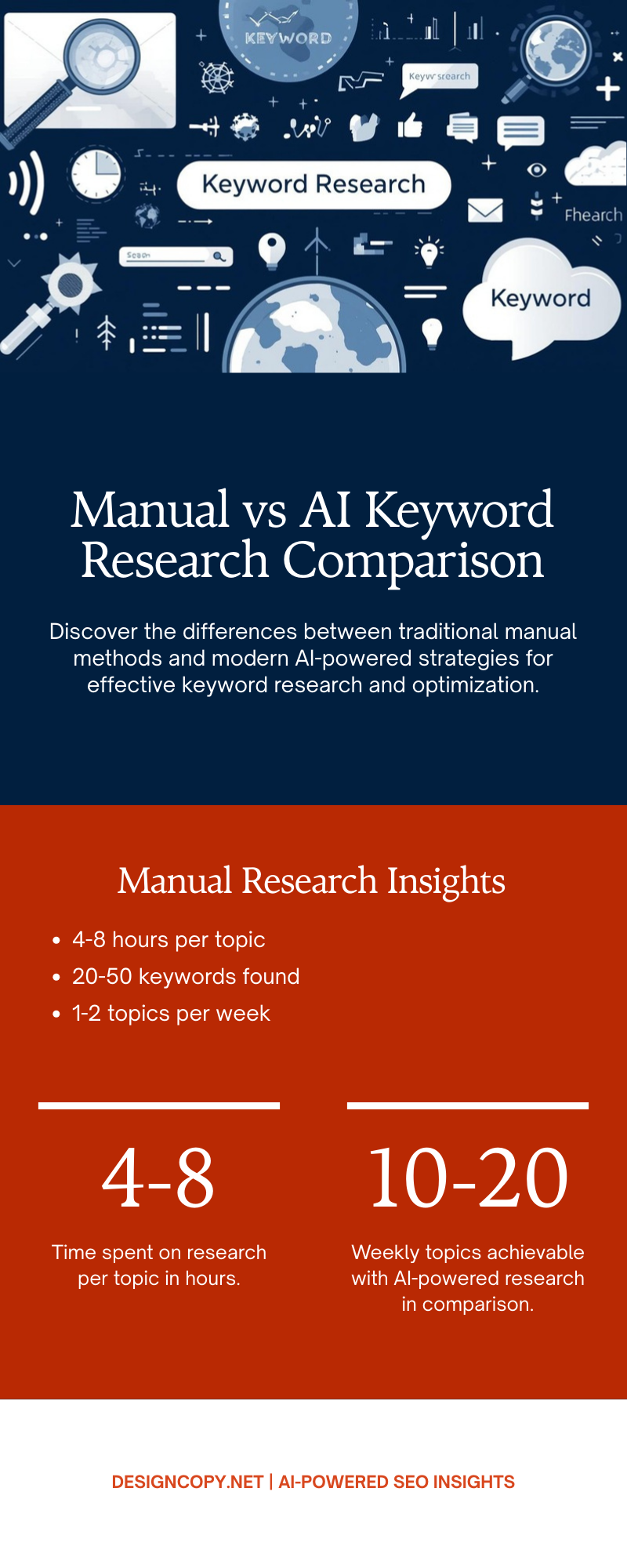
| Factor | Manual Research | AI-Powered Research |
|---|---|---|
| Speed | 4-8 hours per topic | 15-30 minutes per topic |
| Keywords found | 20-50 terms | 200-500+ terms |
| Intent detection | Manual judgment | Automated classification |
| Clustering | Spreadsheet sorting | Automatic grouping |
| Scalability | 1-2 topics per week | 10-20 topics per week |
| Cost | Staff time (~$200/topic) | Tool subscription ($20-$119/mo) |
Two types of AI keyword research tools exist. They work very differently.
SEO platforms like Semrush and Ahrefs use massive search databases. They pull real search volume, click data, and ranking difficulty from actual search behavior. These numbers are grounded in real data.
Large language models (LLMs) like ChatGPT and Claude use language patterns instead. They brainstorm keyword ideas, classify search intent, and generate content briefs. But they don’t have real search volume data. They can — and do — hallucinate metrics.
The hybrid approach works best. Use LLMs for brainstorming and clustering. Then validate everything with an SEO platform for real numbers. That’s the system we use at DesignCopy.
Here’s what that looks like in practice. You give ChatGPT a seed topic and get 50 keyword ideas in two minutes. Then you paste those into Semrush to check real search volume. In 30 minutes, you have a validated keyword map that would have taken a full day manually.
> Key insight: AI doesn’t replace keyword research. It replaces the boring parts. You still need editorial judgment and real SEO strategies.
Related: AI vs Manual Keyword Research → (coming soon)
Best AI Keyword Research Tools — 2026 Comparison
We tested paid and free AI tools for six months. Here’s what actually works — and what doesn’t live up to the hype.
SEO Platforms with AI
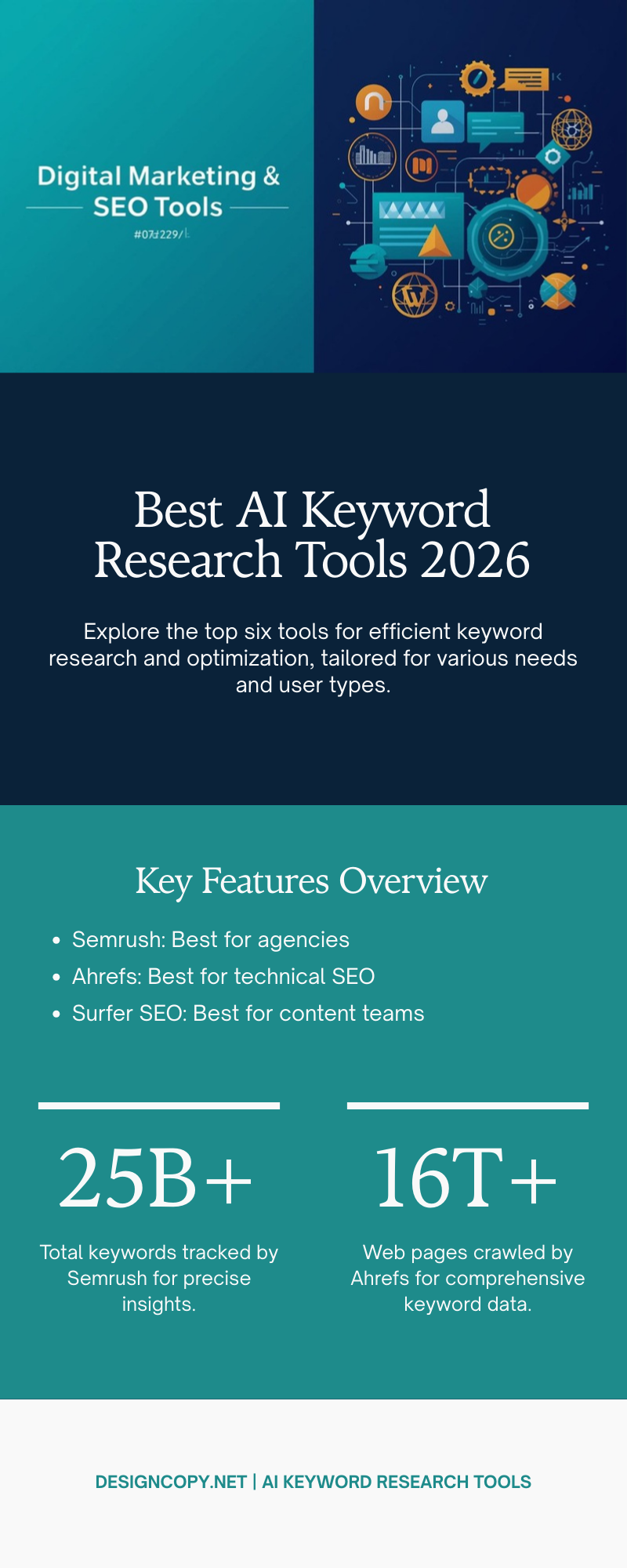
Semrush is the most complete AI keyword research tool on the market. Its database covers 25 billion+ keywords globally. The AI-powered PKD (Personal Keyword Difficulty) scoring tells you how hard a keyword is for your specific site — not just in general.
The automatic keyword clustering feature groups related terms by topic and intent. We found it accurate about 85% of the time during testing. The Keyword Magic Tool alone justifies the price for teams doing serious research.
Best for: Agencies and teams managing multiple sites. Pricing: $119/mo.
Ahrefs is built on clickstream data. That means more accurate click metrics than competitors. When Semrush says a keyword gets 1,000 searches, Ahrefs might show only 600 actual clicks — because AI Overviews absorb the rest.
The parent topic identification helps you avoid creating redundant content. AI keyword suggestions surface related terms you might miss.
Best for: Technical SEO professionals. Pricing: $99/mo.
Surfer SEO focuses on SERP analysis and content scoring rather than raw keyword discovery. It analyzes the top-ranking pages for any keyword and tells you exactly what to include.
It pairs well with a keyword research tool like Semrush for the discovery phase. Use Semrush to find keywords, then Surfer to optimize your content for them.
Best for: Content teams and writers. Pricing: $59/mo.
Free and AI-Native Tools
ChatGPT is excellent for brainstorming and clustering keywords. Give it a topic and it generates dozens of variations in seconds. It has no real search volume data, but the prompt flexibility is unmatched for ideation.
We use it daily for the first step of every keyword project. See our prompts section below for the exact templates.
Best for: Brainstorming and keyword expansion. Pricing: Free / $20 for GPT-4.
Claude is stronger for analysis depth and structured outputs. It handles complex instructions better than ChatGPT for multi-step keyword analysis. It can also analyze screenshots of competitor pages and SERPs directly.
Best for: Strategy and research briefs. Pricing: Free / $20 for Pro.
Google Keyword Planner is the only source of official Google search volume data. The AI features are limited. But every keyword strategy needs real numbers, and this tool provides them for free.
Best for: Volume and CPC verification. Pricing: Free.
Ubersuggest is a solid starter keyword research tool with AI suggestions built in. The interface is simpler than Semrush or Ahrefs. Good for small businesses on a budget who need reliable basics.
Best for: Beginners and solo sites. Pricing: $29/mo.
Head-to-Head Comparison
| Feature | Semrush | Ahrefs | ChatGPT | Claude | Ubersuggest |
|---|---|---|---|---|---|
| Real search volume | ✓ (25B+ DB) | ✓ (clickstream) | ✗ | ✗ | ✓ (limited) |
| AI clustering | ✓ (auto) | ✓ (basic) | ✓ (manual) | ✓ (manual) | ✗ |
| Intent detection | ✓ (auto) | ✓ (auto) | ✓ (prompt) | ✓ (prompt) | Limited |
| Competitor gap | ✓ | ✓ | ✗ | Partial | ✓ |
| Pricing | $119/mo | $99/mo | Free/$20 | Free/$20 | $29/mo |
| Best for | Agencies | Technical SEO | Ideation | Strategy | Small biz |
Our verdict: Start free with ChatGPT + Google Keyword Planner. That combo costs nothing and handles brainstorming plus validation. Upgrade to Semrush when you need scale and automation.
One thing to note: No single AI tool does everything well. The best SEO strategies combine multiple tools. Use an LLM for ideation, an SEO platform for data, and a content tool like Surfer for optimization.
Try our free tools: Keyword Intent Classifier | Keyword Density Checker
Related: Best AI Keyword Research Tools 2026 → (coming soon) | Semrush AI Features → (coming soon)
The Cluster-First AI Keyword Method
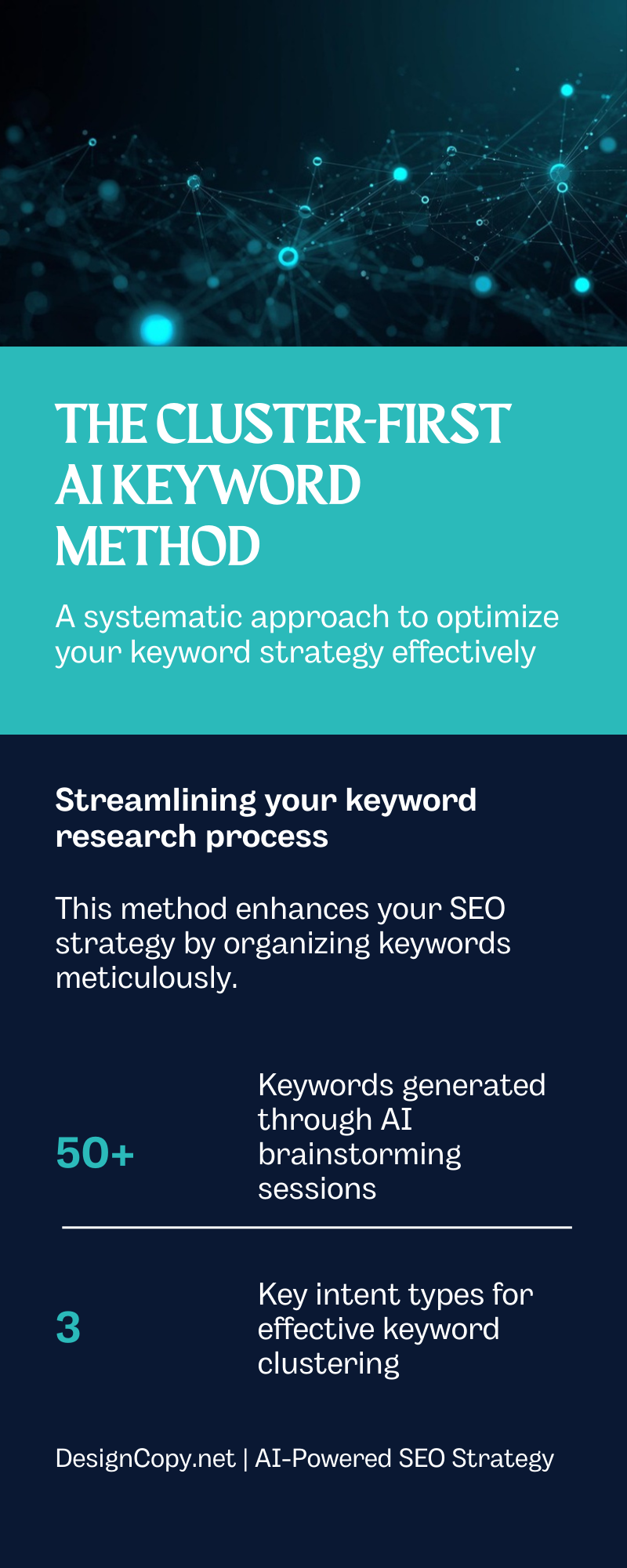
Most keyword guides tell you to find keywords one at a time. We built a method that creates entire content strategies from a single seed keyword.
We call it the Cluster-First Method. It’s the system behind every piece of content on this site. It works for any niche, any budget, and any experience level.
The 5-Step Process
1. Seed with AI
Use ChatGPT or Claude to brainstorm 50+ keyword variations from one topic. Don’t filter yet. Search volume doesn’t matter at this stage. Just generate as many ideas as possible.
Start broad. An AI tool like ChatGPT can produce variations you’d never think of manually. Ask for question keywords, comparison keywords, and long-tail keywords separately.
2. Validate with data
Run your full list through Semrush, Ahrefs, or Google Keyword Planner. Get real search volume and keyword difficulty scores. Drop anything with zero volume or extreme difficulty.
This step is critical. Without it, you’re building a content strategy on guesses.
3. Cluster by intent
Group keywords by search intent — informational, commercial, or transactional. Most people stop at topic grouping. Intent grouping is what separates good SEO strategies from great ones.
A keyword like “ai keyword research” has mixed intent. “Best ai keyword research tools 2026” is clearly commercial. “How to use ai for keyword research” is informational. Each needs different content.
4. Map to content architecture
Assign each cluster to a content type. High-volume mixed-intent clusters become pillar pages. Specific long-tail keywords become supporting posts. Commercial terms become comparison pages.
This is where keyword research becomes a content strategy.
5. Prioritize by opportunity
Score each cluster with this formula: (search volume × intent match) ÷ difficulty. This highlights keywords where the opportunity is real — decent volume, good fit, and competition you can beat.
Focus on clusters that score highest first. Build those pages, then move down the list. This prevents you from chasing vanity keywords you can’t rank for.
Worked Example: This Page
Here’s exactly how we applied the Cluster-First Method for the article you’re reading.
Seed keyword: “ai keyword research”
From that one term, we generated 50+ variations with ChatGPT. After validation in Semrush and Google Keyword Planner, we kept 20 keywords with real search volume. We clustered them by intent:
- Pillar (this page): “ai keyword research” — 2,400 searches/mo, mixed intent
- Supporting posts: “best ai keyword research tools 2026” (commercial), “chatgpt keyword research” (informational), “ai keyword clustering” (informational), plus 7 more
- Long-tail targets: “ai keyword research for small business,” “how to automate keyword research with ai,” “using claude for seo keyword strategy”
The pillar page targets the highest-volume keyword. Each supporting post targets a specific long-tail keyword that links back to the pillar. This builds topical authority faster than publishing random, disconnected articles.
> One seed keyword. Five steps. Twenty content pieces. That’s the Cluster-First Method in action.
Related: AI Keyword Clustering Guide → (coming soon)
Copy-Paste AI Prompts for Keyword Research
Stop staring at blank screens. These four prompt templates work right now. We use them weekly at DesignCopy.
Copy them directly into ChatGPT or Claude. Replace the bracketed text with your own details. Each prompt is optimized for a specific stage of the keyword research process.
Prompt 1: Keyword Brainstorm
Best with: ChatGPT or Claude
Act as an SEO analyst specializing in [your niche].

Generate 30 keyword variations for the topic "[your topic]".

Organize them into three groups:
- Informational intent (questions, how-tos, guides)
- Commercial intent (comparisons, reviews, "best" lists)
- Transactional intent (buy, pricing, tools, free)

For each keyword, estimate relative search interest
(high/medium/low).
Prompt 2: Competitor Gap Analysis
Best with: Claude (handles structured analysis well)
I compete in [your niche]. My site covers these topics:
[list 3-5 main topics].

Analyze these three competitor URLs:
- [URL 1]
- [URL 2]
- [URL 3]

Identify keyword topics they cover that I'm missing.
Group the gaps by priority: quick wins vs long-term targets.
Prompt 3: Long-Tail Expansion
Best with: ChatGPT
Take the seed keyword "[your keyword]".

Generate 20 long-tail keyword variations with commercial
or transactional intent.

Each variation should be 4-8 words long.
Focus on keywords that show the searcher is ready to act.
Prompt 4: Content Brief from Cluster
Best with: Claude
Given this keyword cluster:
- Primary: [main keyword]
- Supporting: [keyword 2], [keyword 3], [keyword 4]

Create a content brief with:
- Suggested H1 and H2 structure
- Target word count
- Search intent for each section
- 3 internal linking opportunities
> Warning: Always validate AI-suggested keywords with real search data. Chatbots hallucinate metrics. ChatGPT and Claude cannot tell you actual search volume numbers.
Pro tip: Save your best prompts in a document. Tweak them over time based on what produces the best results. A good prompt library becomes one of your most valuable SEO assets.
A note on AI search and GEO: Google’s AI Overviews favor long-tail, question-based queries. Queries with 8+ words are where AI search and traditional search engine optimization overlap most productively.
This means your keyword strategy should prioritize specific, question-based terms. These queries are harder for AI Overviews to fully answer, so they still drive clicks to your content.
Related: ChatGPT for Keyword Research → (coming soon) | Using Claude for SEO → (coming soon)
Mistakes to Avoid with AI Keyword Research
Four mistakes kill most AI keyword research efforts. Here’s what they are and how to fix them.
1. Trusting AI search volumes. ChatGPT and Claude don’t access real search data. They estimate — and often fabricate convincing numbers. We’ve seen ChatGPT claim a keyword gets “12,000 monthly searches” when the real number is 200. Always validate with Semrush, Ahrefs, or Google Keyword Planner.
2. Targeting one keyword per page. The one-keyword-per-page approach is outdated. Google now understands topic relationships, not just exact matches. Cluster-based targeting works better in 2026. Group related terms on the same page to build topical authority with search engines.
3. Ignoring search intent. High search volume plus wrong intent equals wasted content. A commercial keyword needs a comparison page, not a tutorial. An informational keyword needs a guide, not a product page. Always match your content format to what the searcher actually wants.
4. Publishing raw AI output. AI gives you 80% of the work. But that last 20% — your expertise, real data, original examples, and editorial voice — is what actually ranks. Search engines reward original insight and first-hand experience. Add your own testing results, opinions, and data to every piece.
Frequently Asked Questions
What is the best free AI tool for keyword research?
ChatGPT paired with Google Keyword Planner is the best free combination. ChatGPT handles brainstorming, clustering, and prompt-based exploration. Google Keyword Planner provides real search volume data to validate those ideas. Together, they cost nothing and cover both sides of the process.
Can AI replace traditional keyword research tools like Semrush?
Not yet. LLMs like ChatGPT and Claude are powerful for ideation and analysis. But they lack real search volume databases, click data, and ranking difficulty scores. The best SEO strategies combine AI tools with traditional SEO platforms for a complete picture.
How accurate is ChatGPT for keyword research?
ChatGPT is excellent for ideation but unreliable for metrics. It generates relevant keyword ideas and clusters them well. But any search volume or difficulty numbers it provides are fabricated. Always cross-reference with a keyword research tool that uses real search engine data.
What is AI keyword clustering and why does it matter?
AI keyword clustering groups related keywords by topic and intent automatically. Instead of targeting keywords one by one, you build content around clusters. This signals topical authority to search engines and helps you rank for more terms with fewer pages.
How do AI Overviews affect keyword research strategy?
AI Overviews reduce organic clicks on informational queries by roughly 35%. Pure informational, short-tail keywords are now less valuable. Focus on long-tail keywords, commercial intent terms, and question-based queries that AI Overviews are less likely to fully answer.
How many keywords should I target per page?
Target one primary keyword and 3-8 secondary keywords per page. Group them by search intent using the cluster approach. Your primary keyword goes in the title, H1, and meta description. Secondary keywords get woven into H2s and body content naturally.
Your Next Steps
Pick the path that matches your level. Start where you are and scale up when you’re ready.
- Beginners: Start with ChatGPT + Google Keyword Planner. It’s free and covers brainstorming plus validation. Follow our Cluster-First Method with just one seed keyword. Build your first cluster before investing in paid tools.
- Intermediate: Try the full Cluster-First Method with Ubersuggest ($29/mo). Build your first complete keyword cluster and map it to a content strategy. Aim for one pillar page supported by 5-10 targeted posts.
- Advanced: Run the full stack — Claude for strategy, Semrush for data validation, and our free tools for on-page optimization. Use the prompt library above to automate your workflow.
Try our free SEO tools today:
- Keyword Intent Classifier — Classify any keyword’s search intent instantly
- Keyword Density Checker — Check keyword density across any page
AI keyword research isn’t about replacing your judgment. It’s about amplifying it. The tools do the heavy lifting. You bring the strategy.
Explore our complete AI-Powered SEO Guide → for more strategies, tools, and frameworks.





 English
  한국어
한국어 