
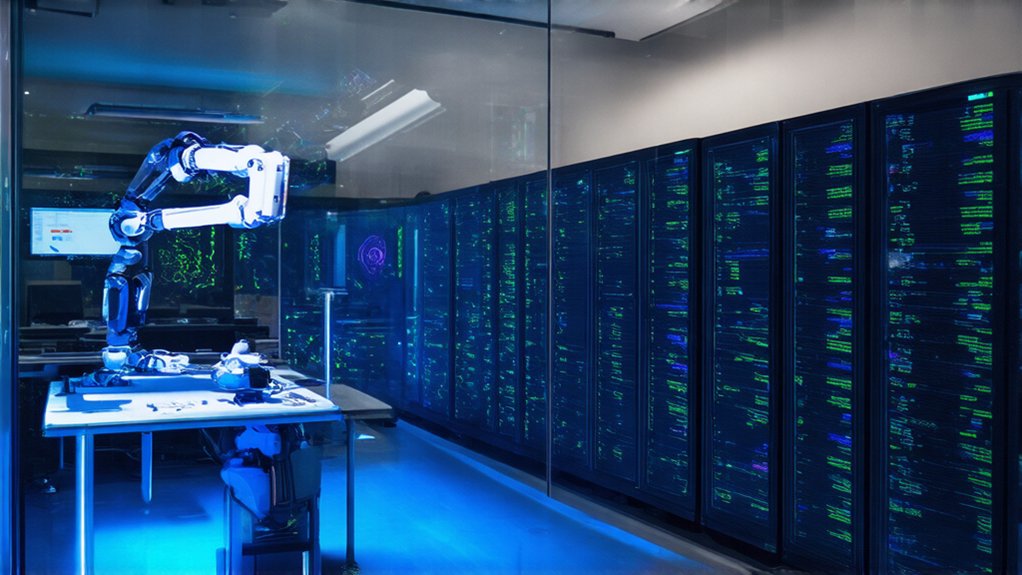
Few research laboratories have transformed our understanding of artificial intelligence as dramatically as DeepMind. Founded in 2010 as an independent AI company, it’s now part of Google‘s empire and recently merged with Google Brain. Not your average tech lab. This place blends machine learning, neuroscience, engineering, mathematics, and computing infrastructure like it’s mixing a particularly complex cocktail.
DeepMind isn’t just changing AI—it’s redefining it with a dizzying fusion of disciplines that even Google couldn’t resist absorbing. DeepMind’s acquisition by Google in 2014 was valued at $500 million, marking one of the largest AI company purchases at the time, per TechCrunch.
Their breakthrough? AlphaGo. The program shocked the world in 2015 by defeating a Go world champion—something experts thought was a decade away. The AI was apparently bored with just mastering one game, so DeepMind created AlphaZero and MuZero, systems capable of solving various games and real-world problems. Show-offs. The lab leverages transformer architecture to process massive amounts of text data in parallel, enabling breakthrough capabilities in language understanding. AlphaGo achieved a 99.8% win rate against top Go players before retiring, per DeepMind’s 2019 announcement.
The lab itself is a playground for AI development. DeepMind Lab offers a 3D platform with a first-person viewpoint where AI agents navigate mazes and collect fruit in science fiction-style environments. Sounds fun, right? These aren’t just games though. The robots have learned to play soccer without human programming, developing their own bizarre strategies and movements. No one told them the rules—they just figured it out. DeepMind is dedicated to creating general agents that can autonomously operate across a wide variety of tasks without specific programming.
Google’s massive computing infrastructure backs all this innovation. Facilities like the one in Pryor, Oklahoma, give DeepMind the computational muscle to simulate neural networks and approximate brain functions. Without this computing power, none of their fancy AI tricks would work. A 2023 report from OpenAI estimates that training advanced AI models like DeepMind’s requires over 1,000 petaflop/s-days of computing power. A 2023 report by OpenAI estimates that training advanced AI models requires over 1,000 petaflop/s-days of computing power.
The research culture at DeepMind is distinctly academic, with scientifically named workspaces and an extensive library of resources. They host an AI for Science Forum and work on projects that actually matter, like AlphaFold for protein folding and research to reduce methane emissions through gene-edited cows. Their revolutionary AlphaFold program can solve protein structures in seconds that would take traditional methods years to complete.
Despite all this progress, the debate rages on. Will AI benefit humanity or destroy it? DeepMind’s introducing their creations gradually, giving society time to adapt. Smart move. When your robots are learning to play soccer on their own, maybe you shouldn’t rush things.

 English
  한국어
한국어 