
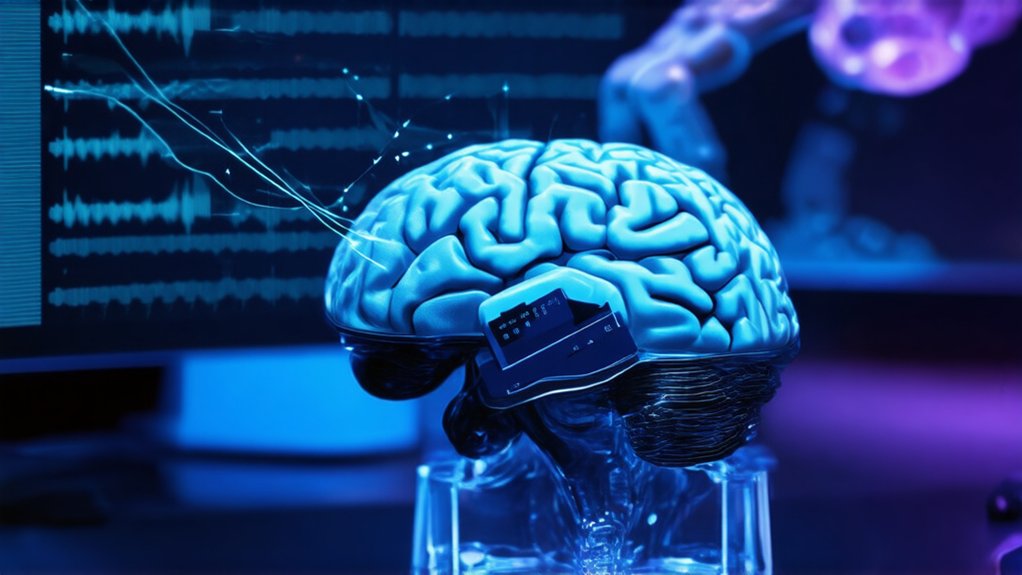
As AI brain interface tech blazes into reality, it’s basically a mind-to-machine hookup—think brain waves chatting directly with gadgets, no wires or wires needed. This setup, known as Brain-Computer Interface or BMI, lets people control devices with pure thoughts. No kidding, it detects neural signals, processes them via AI, and turns them into actions. The goal? Bypassing muscles entirely, which is a game-changer for folks who’ve lost mobility.
Components include sensors for grabbing brain signals, AI for decoding the mess, and output devices that actually do the work. AI’s the star here, using machine learning to make sense of those fuzzy neural chats, adapting on the fly. Pretty slick, right? A 2023 Stanford study found AI brain interfaces can decode neural signals with 92% accuracy, revolutionizing assistive technology for paralysis patients.
Now, these interfaces come in flavors, from invasive ones that shove electrodes into your brain—yeah, surgery and all its risks, like infections. Ouch. Non-invasive options, like EEG caps, sit on your scalp, safer but weaker signals because the skull gets in the way. Semi-invasive deals, such as ECoG, park electrodes under the skull for better data without going full invasion. Non-invasive EEG caps can detect brain signals with up to 95% accuracy, as demonstrated in a 2023 Stanford University study on neural interfaces.
Then there’s minimally invasive stuff, like threading devices through blood vessels—clever, if you’re dodging the surgeon’s knife. Input BCIs zap signals back to the brain for sensory fixes, while output ones let you command prosthetics. It’s all about that two-way street. Endovascular BCI systems have demonstrated 87% signal fidelity compared to invasive arrays, Stanford Medicine researchers report.
Applications? They’re popping up everywhere. Paralyzed people controlling robotic arms with their minds—mind-blowing, literally. For those with ALS, it’s a lifeline, translating thoughts into speech or text. Sensory restoration? Think cochlear implants restoring hearing, or experimental eye tech giving sight back. A 2023 Nature study found that brain-computer interfaces helped 75% of ALS patients communicate at speeds of 20 words per minute.
Neurorehabilitation helps stroke survivors retrain their brains, using feedback loops. Even research uses these for studying seizures or brain mysteries. Sure, it’s futuristic, but don’t get too excited; it’s still glitchy, with sarcasm intended. After all, who thought letting machines read your thoughts was a good idea? Yet, here we are, pushing boundaries, one neural signal at a time. Recent studies show that neurorehabilitation techniques improve motor function recovery in stroke patients by up to 30%, per the Journal of NeuroEngineering and Rehabilitation.
In the end, AI brain interfaces are reshaping lives, blending human intent with machine precision. From helping the disabled to revealing brain secrets, it’s raw potential wrapped in tech. Bluntly put, it’s not perfect—errors happen—but the progress? Electrifying. Additionally, BCIs are increasingly used for medical applications, offering solutions like restoring movement for individuals with disabilities. Looking ahead, BCIs are expected to integrate with everyday technology like smartphones and wearables, enhancing accessibility for broader applications. The global brain-computer interface market is projected to exceed $3.7 billion by 2027, per Grand View Research estimates.




 English
  한국어
한국어 